This document is relevant for: Trn2, Trn3
AveragePool2D#
In this tutorial, we examine a case of dimensionality reduction. We implement a 2D AveragePool operation, which is used in many vision neural networks. In doing so, we learn about:
NKI syntax and programming model.
multi-dimensional memory access patterns in NKI.
The 2D AveragePool operation takes
C x [H,W] matrices and reduces each matrix along the H and W
axes. To leverage free-dimension flexible indexing, we can map the C
(parallel) axis to the P dimension and H/W (contraction)
axes to the F dimension.
Performing such a 2D pooling operation requires a 4D memory access
pattern in the F dimension, with reduction along two axes.
Figure
below illustrates the input and output tensor layouts.
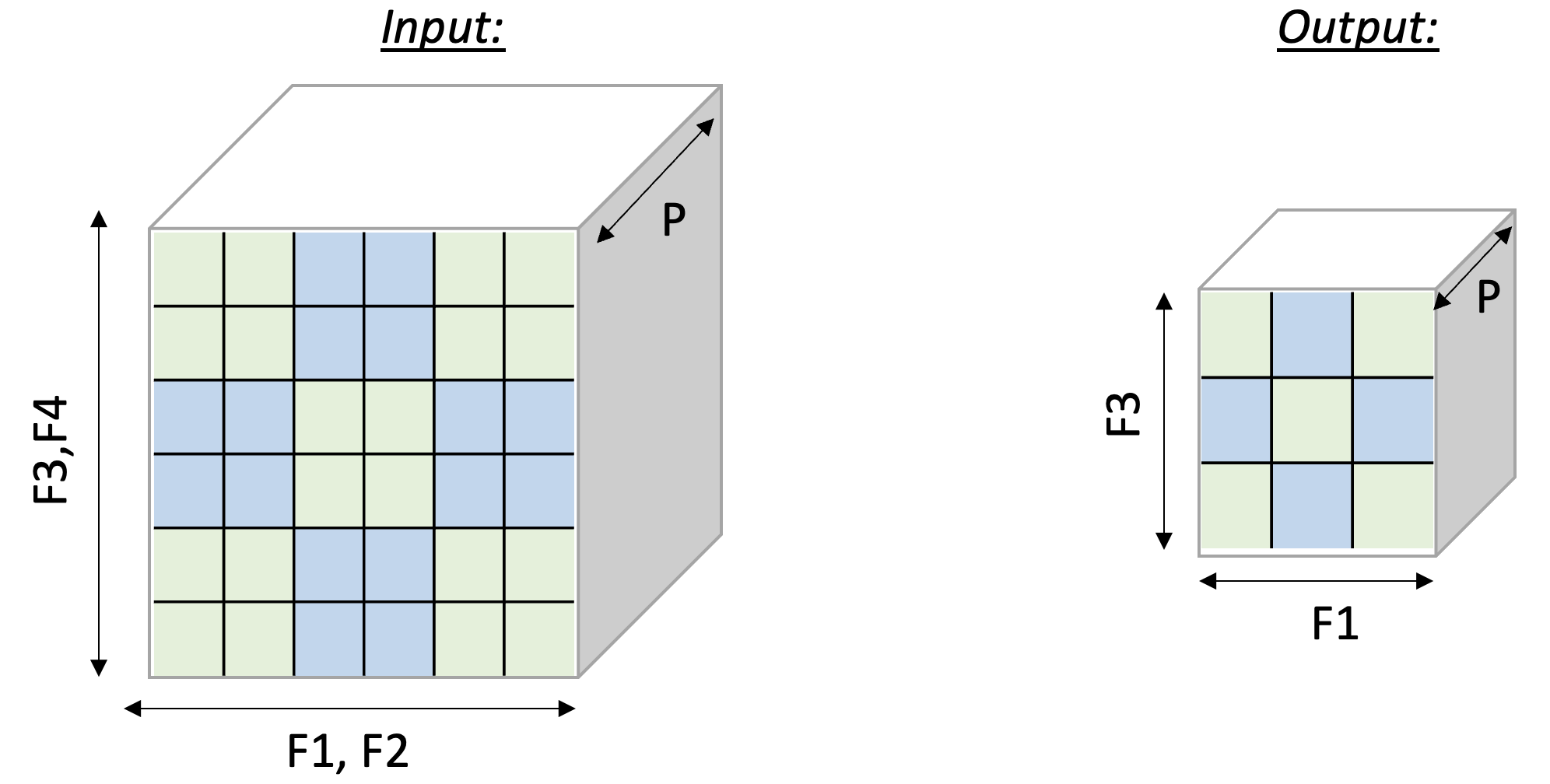
Fig. 18 2D-Pooling Operation (reducing on axes F2 and F4)#
PyTorch#
Compute kernel#
 1import nki
 2import nki.isa as nisa
 3import nki.language as nl
 4from nki.typing import tensor
 5
 6@nki.jit
 7def tensor_avgpool_kernel(in_tensor, pool_size):
 8  """NKI kernel to compute a 2D avg-pool operation
 9
10  Args:
11      in_tensor: an input tensor, of shape C x H x W
12      pool_size: an integer representing a (square) pool-window size
13
14  Return:
15      out_tensor: the resulting output tensor, of shape C x (H/pool_size) x (W/pool_size)
16  """
17
18  # Get input/output dimensions
19  sz_cin, sz_hin, sz_win = in_tensor.shape
20  sz_hout = sz_hin // pool_size
21  sz_wout = sz_win // pool_size
22  # Create output tensor shared between all SPMD instances as result tensor
23  out_tensor = nl.ndarray((sz_cin, sz_hout, sz_wout), dtype=in_tensor.dtype,
24                          buffer=nl.shared_hbm)
25
26  # Set relevant sizes
27  sz_p = sz_cin
28  sz_pool = pool_size
29
30  # Generate pool access pattern to create a 5D view:
31  # [sz_p, sz_hout, sz_wout, sz_pool, sz_pool]
32  # The pool dimensions are placed last so we can reduce over them.
33
34  # Load input data from external memory to on-chip memory
35  in_tile = nl.ndarray(in_tensor.shape, dtype=in_tensor.dtype, buffer=nl.sbuf)
36  nisa.dma_copy(dst=in_tile, src=in_tensor)
37
38  # Perform the pooling operation using an access pattern view:
39  # The .ap() creates a strided 5D view of the 3D input tile,
40  # grouping elements into pool windows for reduction.
41  pool_view = in_tile.ap([
42    [sz_hin * sz_win, sz_p],      # partition stride
43    [sz_pool * sz_win, sz_hin // sz_pool],  # outer row stride
44    [sz_pool, sz_win // sz_pool],            # outer col stride
45    [sz_win, sz_pool],             # inner row stride (within pool window)
46    [1, sz_pool],                  # inner col stride (within pool window)
47  ])
48  sum_tile = nl.sum(pool_view, axis=[3, 4])
49  out_tile = nl.ndarray(sum_tile.shape, dtype=sum_tile.dtype, buffer=nl.sbuf)
50  nisa.tensor_scalar(dst=out_tile, data=sum_tile, op0=nl.multiply,
51                     operand0=1.0 / (pool_size * pool_size))
52
53  # Store the results back to hbm
54  nisa.dma_copy(dst=out_tensor, src=out_tile)
55
56  # Transfer the ownership of `out_tensor` to the caller
57  return out_tensor
Launching kernel and testing correctness#
To execute the kernel, we prepare tensors in_tensor and call tensor_avgpool_kernel:
 1import torch
 2import torch_xla
 3
 4if __name__ == "__main__":
 5  device = torch_xla.device()
 6
 7  # Now let's run the kernel
 8  POOL_SIZE = 2
 9  C, HIN, WIN = 2, 6, 6
10  HOUT, WOUT = HIN//POOL_SIZE, WIN//POOL_SIZE
11
12  in_tensor = torch.arange(C * HIN * WIN, dtype=torch.bfloat16).reshape(C, HIN, WIN).to(device=device)
13  out_nki = torch.zeros((C, HOUT, WOUT), dtype=torch.bfloat16).to(device=device)
14
15  out_nki = tensor_avgpool_kernel(in_tensor, POOL_SIZE)
16
17  out_torch = torch.nn.functional.avg_pool2d(in_tensor, POOL_SIZE, POOL_SIZE)
18
19  print(in_tensor, out_nki, out_torch) # an implicit XLA barrier/mark-step
20
21  if (out_nki == out_torch).all():
22    print("NKI and Torch match")
23  else:
24    print("NKI and Torch differ")
JAX#
Compute kernel#
Let’s reuse the same NKI kernel implementation defined for PyTorch above:
 1import nki
 2import nki.isa as nisa
 3import nki.language as nl
 4from nki.typing import tensor
 5
 6@nki.jit
 7def tensor_avgpool_kernel(in_tensor, pool_size):
 8  """NKI kernel to compute a 2D avg-pool operation
 9
10  Args:
11      in_tensor: an input tensor, of shape C x H x W
12      pool_size: an integer representing a (square) pool-window size
13
14  Return:
15      out_tensor: the resulting output tensor, of shape C x (H/pool_size) x (W/pool_size)
16  """
17
18  # Get input/output dimensions
19  sz_cin, sz_hin, sz_win = in_tensor.shape
20  sz_hout = sz_hin // pool_size
21  sz_wout = sz_win // pool_size
22  # Create output tensor shared between all SPMD instances as result tensor
23  out_tensor = nl.ndarray((sz_cin, sz_hout, sz_wout), dtype=in_tensor.dtype,
24                          buffer=nl.shared_hbm)
25
26  # Set relevant sizes
27  sz_p = sz_cin
28  sz_pool = pool_size
29
30  # Generate pool access pattern to create a 5D view:
31  # [sz_p, sz_hout, sz_wout, sz_pool, sz_pool]
32  # The pool dimensions are placed last so we can reduce over them.
33
34  # Load input data from external memory to on-chip memory
35  in_tile = nl.ndarray(in_tensor.shape, dtype=in_tensor.dtype, buffer=nl.sbuf)
36  nisa.dma_copy(dst=in_tile, src=in_tensor)
37
38  # Perform the pooling operation using an access pattern view:
39  # The .ap() creates a strided 5D view of the 3D input tile,
40  # grouping elements into pool windows for reduction.
41  pool_view = in_tile.ap([
42    [sz_hin * sz_win, sz_p],      # partition stride
43    [sz_pool * sz_win, sz_hin // sz_pool],  # outer row stride
44    [sz_pool, sz_win // sz_pool],            # outer col stride
45    [sz_win, sz_pool],             # inner row stride (within pool window)
46    [1, sz_pool],                  # inner col stride (within pool window)
47  ])
48  sum_tile = nl.sum(pool_view, axis=[3, 4])
49  out_tile = nl.ndarray(sum_tile.shape, dtype=sum_tile.dtype, buffer=nl.sbuf)
50  nisa.tensor_scalar(dst=out_tile, data=sum_tile, op0=nl.multiply,
51                     operand0=1.0 / (pool_size * pool_size))
52
53  # Store the results back to hbm
54  nisa.dma_copy(dst=out_tensor, src=out_tile)
55
56  # Transfer the ownership of `out_tensor` to the caller
57  return out_tensor
In order to pass pool_size as a compile time constant, we pass pool_size as kwargs.
out_nki = tensor_avgpool_kernel(in_array, pool_size=POOL_SIZE)
We write a reference JAX implementation of AveragePool2D as JAX does
not have a primitive for it.
1import jax.numpy as jnp
2
3# Reference JAX implementation
4def jax_average_pool_2D(in_tensor, pool_size):
5  c, h_in, w_in = in_tensor.shape
6  reshaped = in_tensor.reshape(c, h_in // pool_size, pool_size, w_in // pool_size, pool_size)
7  return jnp.nanmean(reshaped, axis=(2, 4))
Launching kernel and testing correctness#
To execute the kernel, we prepare array in_array and invoke the kernel caller function tensor_avgpool_kernel:
 1if __name__ == "__main__":
 2  POOL_SIZE = 2
 3  C, HIN, WIN = 2, 6, 6
 4  HOUT, WOUT = HIN//POOL_SIZE, WIN//POOL_SIZE
 5
 6  in_array = jnp.arange(C * HIN * WIN, dtype=jnp.float32).reshape(C, HIN, WIN)
 7
 8  out_nki = tensor_avgpool_kernel(in_array, pool_size=POOL_SIZE)
 9  out_jax = jax_average_pool_2D(in_array, pool_size=POOL_SIZE)
10
11  print(in_array, out_nki, out_jax)
12
13  if jnp.allclose(out_nki, out_jax):
14    print("NKI and JAX match")
15  else:
16    print("NKI and JAX differ")
Download All Source Code#
Click the links to download source code of the kernels and the testing code discussed in this tutorial.
NKI baremetal implementation:
average_pool2d_nki_kernels.py- PyTorch implementation:
average_pool2d_torch.py You must also download
average_pool2d_nki_kernels.pyinto the same folder to run this PyTorch script.
- PyTorch implementation:
- JAX implementation:
average_pool2d_jax.py You must also download
average_pool2d_nki_kernels.pyinto the same folder to run this JAX script.
- JAX implementation:
You can also view the source code in the GitHub repository nki_samples
Example usage of the scripts:#
Run NKI baremetal implementation:
python3 average_pool2d_nki_kernels.py
Run PyTorch implementation:
python3 average_pool2d_torch.py
Run JAX implementation:
python3 average_pool2d_jax.py
This document is relevant for: Trn2, Trn3