This document is relevant for: Trn2, Trn3
NKI Access Patterns#
NKI supports hardware-native access patterns (APs) on NkiTensor via
the NkiTensor.ap() method, letting developers specify precisely
what they want their instructions to read from on the hardware.
For most code, the higher-level NkiTensor view primitives (slice,
reshape, permute, broadcast, select, view(dtype), etc.)
should be sufficient. See the Tensor Values
section of the NKI Language Guide for an overview of those primitives.
When none of the NkiTensor wrapper APIs expresses the access pattern you
need, one can use the lower-level .ap() API, which can express any
access pattern the hardware supports.
Note
The NkiTensor view primitives are implemented on top of .ap():
each view method composes a hardware access pattern at specialization
time, without any runtime cost. .ap() is the raw building block.
Hardware Capability#
Instructions can read and write tensors from/to the SBUF or PSUM, which are both two-dimensional memories with 128 partitions on NeuronCore v2/v3/v4. Within each SBUF/PSUM partition, the tensor read/write logic on the NeuronCore supports accessing elements from up to four-dimensional arrays, though most instructions only support 1D/2D/3D in the free dimension due to instruction length limitations.
The multi-dimensional access patterns are typically described using two pieces
of information: 1) the element stepping (i.e., stride) and 2) number of
elements (i.e., size) in each dimension. A tensor access pattern of an
instruction is expected to be the same across all partitions.
In addition to the free dimension pattern, additional information is required to locate the number of elements to access: 1) the offset from the beginning of the tensor and 2) the number of partitions. The next section will describe how the NKI API abstracts this information.
NKI API for the Access Pattern#
The NKI API for access pattern is a direct reflection of the hardware capability.
The nl.ndarray has an ap method.
def ap(self, pattern: list[list[int]],
   offset: int | None = None,
   scalar_offset: NkiTensor | VirtualRegister | None = None,
   vector_offset: NkiTensor | None = None,
   indirect_dim: int = 0,
   dtype: DType | None = None):
   pass
The parameters have the following definitions:
pattern: A list of two-element tuples, each tuple describes the access on one dimension. The first element represents the element stepping and the second element represents the number of elements in each dimension. This tuple is referred to as[step, num]going forward.The shape of a pattern is the collection of num. For example, given pattern
[[w_step, w_num], [z_step, z_num], [y_step, y_num], [x_step, x_num]], the shape is[w_num, z_num, y_num, x_num].Note: The order of the pattern specified here is in the opposite order to what is actually accepted by the hardware. Therefore, the order of the tuples shown on the profiler will be in the opposite order of what is specified here.
offset: The compile-time integer offset to start the access in terms of number of elements from the beginning of the tensor. WhenNone(the default), the new view inherits the current view’s storage offset. For a runtime (dynamic) offset, usescalar_offsetorvector_offsetinstead.scalar_offset: An SBUF tensor of shape(1, 1)or a VirtualRegister that specifies the location to start the access in terms of number of elements on theindirect_dimof the access pattern. At most one of thescalar_offsetandvector_offsetcan be specified.vector_offset: An SBUF tensor that specifies the location to start the access in terms of number of elements from the beginning of the indirect dimension specified byindirect_dim. At most one of thescalar_offsetandvector_offsetcan be specified.indirect_dim: The indirect dimension on which to applyscalar_offsetandvector_offset.dtype: The data type of the access pattern. The default value is thedtypeof the tensor being accessed.
View Primitives Build APs at Specialization Time#
The higher-level NkiTensor view primitives (slice, reshape,
permute, broadcast, select, view(dtype), rearrange,
etc.) are implemented as NKI meta-programming on top of .ap().
Every view operation runs at specialization time: it reads the current
view’s shape, strides, and offset, applies its transform, and produces
a new NkiTensor whose get_pattern() returns a hardware access
pattern equivalent to the one .ap() would have produced directly.
t = nl.ndarray((128, 64), dtype=nl.float32, buffer=nl.sbuf)
u = t.slice(dim=1, start=8, end=24)
assert u.get_pattern() == [[64, 128], [1, 16]]
assert u.offset == 8

# Equivalent to constructing the same AP by hand with .ap():
v = t.ap(pattern=[[64, 128], [1, 16]], offset=8)
assert v.get_pattern() == u.get_pattern()
assert v.offset == u.offset
Because the view composition happens at specialization time, a chain of view operations has zero runtime cost: only the final pattern is handed to the ISA instruction that consumes the tensor.
Semantics of the Access Pattern#
Access patterns can be thought of as compact representations of a loop. The
offset is an integer indicating the start offset in terms of elements with
respect to the beginning of the tensor. Each two-element list [step, num]
represents the stride in terms of elements and the number of iterations of
each level of the loop. The semantics are explored through the following
example.
Given a tensor, the Access Pattern conceptually flattens the tensor to 1D, and then uses a loop to fetch elements from the tensor to construct a view. Consider the following NKI code:
t = nl.ndarray((p_count, N), dtype=nl.float32, buffer=nl.sbuf)
access = t.ap(
  pattern=[[N, p_size], [z_step, z_num], [
  y_step, y_num], [x_step, x_num]],
  offset)
The above represents the following access on the tensor t, written below in pseudo-code.
access = nl.ndarray((p_size, z_num, y_num, x_num), dtype=nl.float32, buffer=nl.sbuf)
for w in range(p_size):
  for z in range(z_num):
    for y in range(y_num):
      for x in range(x_num):
        t_flatten = t.flatten() # first flatten the tensor to 1d
        access[w, z, y, x] = t_flatten[offset + (w * N) + (z * z_step)
                  + (y * y_step) + (x * x_step)]
The access pattern has the following properties:
1. Recall from the hardware capability, the access pattern in each partition must be identical. Therefore, the step of the first tuple in the AP must be equal to the number of elements in the free dimension of the tensor. 2. The shape of the result view is always the same as the shape of the pattern.
Note that calling .ap on a tensor does not do any computation directly.
It describes how to get data. The engines will consume data when the AP
is passed into a nki.isa instruction.
src = nl.ndarray((16, 32), dtype=nl.float32, buffer=nl.sbuf)
dst = nl.ndarray((16, 32), dtype=nl.float32, buffer=nl.sbuf)
src_access = src.ap([32, 16], [1, 32]) # no computation happens
dst_access = dst.ap([32, 16], [1, 32]) # no computation happens

# Engine reads both src_access and dst_access and performs the copy
nisa.dma_copy(dst_access, src_access)
A Concrete Example#
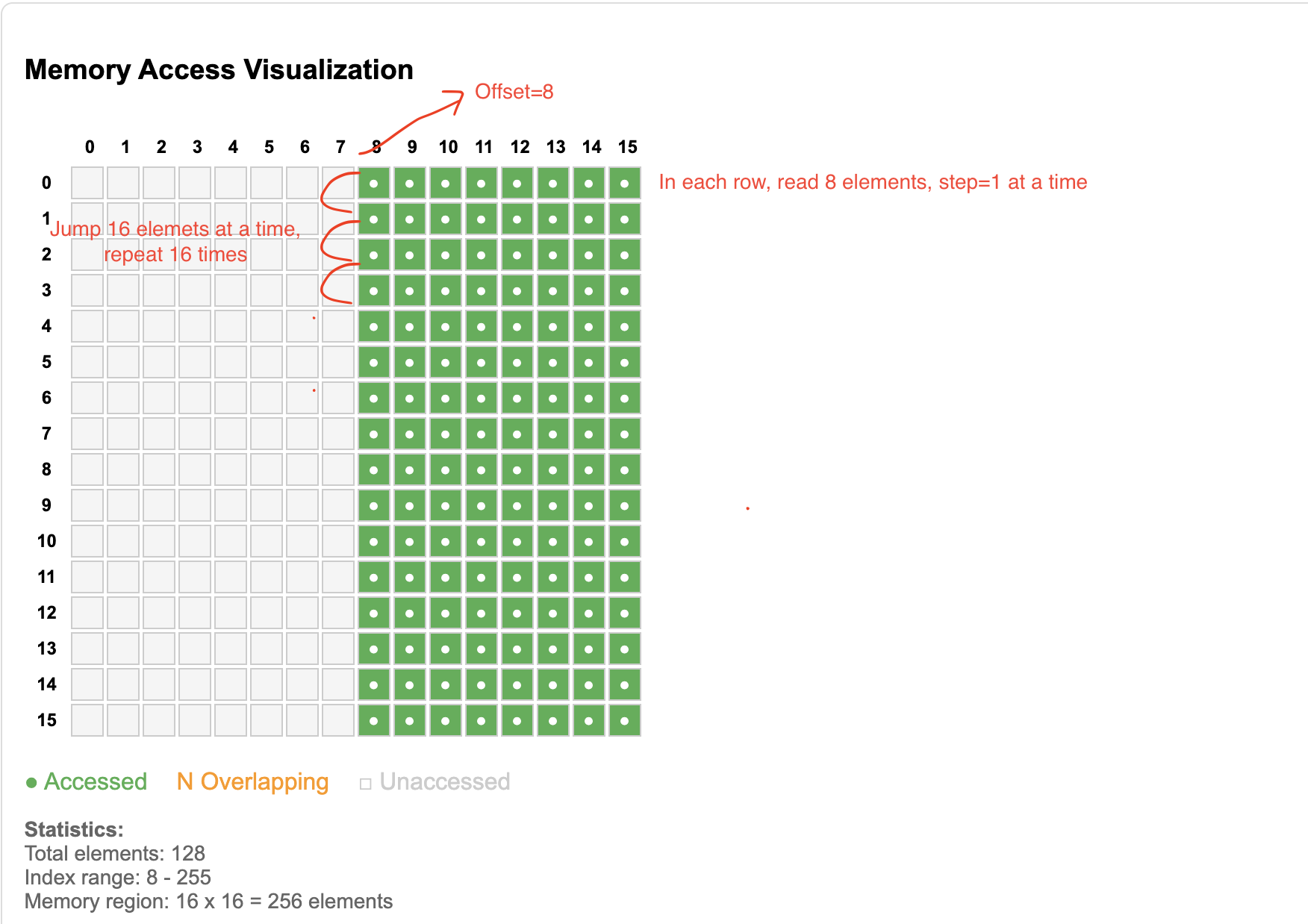
Given a tensor t of size (16P, 16F), to iterate all the elements in
t[0:16, 8:16] the access pattern can be written as:
t = nl.ndarray((16, 16), dtype=nl.float32, buffer=nl.sbuf)
access = t.ap(pattern=[[16, 16], [1, 8]], offset=8)


# Semantics, the following is pseudo-code
access = nl.ndarray((16, 8), dtype=nl.float32, buffer=nl.sbuf)
# in loop form
for w in range(16):
  for z in range(8):
    idx = 8 + (w * 16) + (1 * z)
    t_flatten = t.flatten()
    access[w, z] = t_flatten[idx]
Restriction on SBUF/PSUM Tensors#
For SBUF/PSUM tensors, the first tuple must always be the access for the
partition dimension. On NeuronCore v2/v3/v4, the access on the partition
dimension must be contiguous, meaning that the step of the leading dimension
must be the element count of the entire free dimension of the tensor.
Therefore, given a tensor of shape (p_dim, f_dim0, f_dim1), the step of
the leading dimension must be f_dim0 * f_dim1.
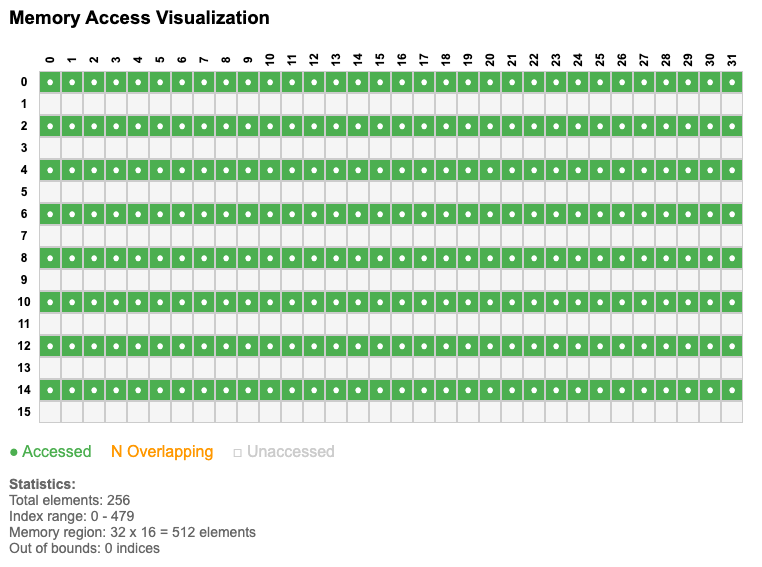
The following example is not allowed because it reads every other partition.
t = nl.ndarray((16, 32), dtype=nl.float32, buffer=nl.sbuf)

# The following is illegal, because the first stride is 32*2 and reads every other partition
t.ap(pattern=[[64, 8], [1, 32]], offset=0)
Composition and .ap on a view#
.ap addresses the tensor’s underlying storage directly: the pattern
and offset are interpreted against storage, ignoring any shape,
strides, or offset carried by the view .ap is called on. In
particular, .ap is not composable: chaining .ap is allowed
but the inner .ap is fully overridden by the outer one:
t = nl.ndarray((128, 256), dtype=nl.float32, buffer=nl.sbuf)
inner = t.ap(pattern=[[256, 128], [2, 128]])
outer = inner.ap(pattern=[[256, 128], [1, 64]])
# outer is equivalent to t.ap(pattern=[[256, 128], [1, 64]]);
# inner's pattern has no effect on outer.
For composable, view-on-view semantics that stay inside the NkiTensor
model, use the higher-level view primitives exposed on NkiTensor
(slice, reshape, permute, broadcast, select,
view(dtype), etc.). They return new NkiTensor views of the same
storage and chain freely:
t = nl.ndarray((128, 256), dtype=nl.float32, buffer=nl.sbuf)

# Compose slicing on both dims, then slice again.
t_a = t.slice(dim=0, start=0, end=128).slice(dim=1, start=0, end=256, step=2)
t_b = t_a.slice(dim=0, start=0, end=64).slice(dim=1, start=0, end=64)
# t_b has shape (64, 64), storage shared with t.
See the Tensor Values section of the NKI Language Guide for the full catalogue of view primitives.
Reinterpret Cast with ap#
The dtype parameter can be used for reinterpret casting the tensor.
Since both the pattern and the offset are in terms of number of elements,
not bytes, the count must be computed accordingly. See the following example
of reinterpret cast from INT32 to BF16.
t = nl.ndarray((128, 256), dtype=nl.int32, buffer=nl.sbuf)
cast_to_bf16 = t.ap(pattern=[
  [512, 128], [1, 512]
 ], # notice the number of elements is doubled due to dtype size change
offset = 0, dtype=nl.bfloat16) # cast_to_bf16 has shape (128, 512)
For the common case of reinterpreting the bits of an existing view
without otherwise changing its layout, NkiTensor.view() is the
idiomatic alternative (e.g. t.view(nl.bfloat16)) and takes care
of scaling the last-dim size automatically.
Dynamic Access with scalar_offset and vector_offset#
The scalar_offset and vector_offset are for dynamic tensor access, i.e. using a
runtime value to index another tensor.
For most dynamic access, the higher-level view primitives
NkiTensor.select() (a single runtime index) and
NkiTensor.vector_select() (a per-partition vector of indices) are
sufficient. They build the same access pattern that the .ap() forms
below produce, without specifying the pattern by hand. The .ap() forms
remain available when you need full control over the pattern.
Scalar Dynamic Access#
When index is a runtime scalar in SBUF (rather than a Python int),
NkiTensor.select() picks one slice along dim at an index resolved
at runtime, removing that dimension.
def scalar_dynamic_select(A):
   # A has shape (4, 128, 512): four (128, 512) batches in HBM.
   # We want the batch at a runtime index held in SBUF.
   batch_idx = nl.ndarray((1, 1), nl.int32, buffer=nl.sbuf)
   nisa.memset(batch_idx, value=3)

   src = A.select(0, batch_idx)   # src has shape (128, 512)

   result = nl.ndarray((128, 512), A.dtype, buffer=nl.shared_hbm)
   nisa.dma_copy(src=src, dst=result[...])
   return result
Only one dynamic select is allowed per view (no chaining); on SBUF / PSUM
tensors the selected dimension must not be the partition dimension (dim 0).
Use NkiTensor.is_indirect() to test whether a view already carries an
indirect index.
The lower-level .ap form takes a scalar_offset: an SBUF value that specifies the index on the indirect_dim of the tensor.
def scalar_dynamic_dma(A):
   # Assume input A is of shape (4*128, 512). We want to copy from A[3*128:, 0:256]
   # The 3*128 offset comes from a dynamic variable in SBUF
   assert A.shape == [512, 512]
   batch_idx = nl.ndarray((1, 1), nl.int32, buffer=nl.sbuf)
   nisa.memset(batch_idx, value=3*128)

   result = nl.ndarray((128, 256), A.dtype, buffer=nl.shared_hbm)

   nisa.dma_copy(src=A.ap(
      pattern=[[512, 128], [1, 256]], offset=0,
      scalar_offset=batch_idx, indirect_dim=0
      ),
      dst=result[...])

   return result
The code block above accesses batch_idx on the 0-th dimension
of the tensor A. Note that the dimension is relative to
the base tensor, not relative to the pattern specified.
This example will access the memory from A starting at the element offset below.
# prod(A.shape[indirect_dim+1:]) is the accumulated shape
# to the right of indirect_dim
offset + scalar_offset * prod(A.shape[indirect_dim+1:])
In the example above, the access starts from:
0 + batch_idx * 512
Again, we should notice that 512 is read from the shape of the base tensor, not from the access pattern. The shape of the access pattern is (128, 256).
Vector Dynamic Access#
NkiTensor.vector_select() reads a different index per output partition,
supplied as a per-partition vector of offsets in SBUF. This is the gather
pattern where different partitions read different rows of the source. dim
must be 0 and the source must be an HBM tensor; the output partition count
is vector_offset.shape[0].
def gather_rows(A):
   # A has shape (128, 512) in HBM. Gather 64 rows chosen at runtime.
   offsets = nl.ndarray((64, 1), nl.int32, nl.sbuf)
   nisa.iota(offsets, [[1, 1]], 0, 2)        # e.g. rows 0, 2, 4, ...

   # partition p reads row offsets[p]; result has shape (64, 512)
   src = A.vector_select(0, offsets)

   result = nl.ndarray((64, 512), nl.float32, buffer=nl.shared_hbm)
   nisa.dma_copy(src=src, dst=result[...])
   return result
The result is an indirect view: the selected dimension cannot be further sliced or selected, and only one dynamic select is allowed per tensor.
The lower-level .ap form takes a vector_offset. Vector dynamic access is similar to that of scalar, except that the dynamic offsets are in a vector.
Specify the field vector_offset. Currently, only ``indirect_dim=0`` is supported.
The stride on the leading dimension must be the total number of elements to the right of the
leading dimension in the base tensor, and the stride specified in the
leading dimension of the pattern in the .ap() is currently ignored.
We still recommend setting the stride properly so that code would still work
if this limitation is lifted in the future.
def indirect_vector_dynamic_dma(A):
   # shape of A is (128, 512)
   dynamic_idx_legal = nl.ndarray((64, 1), nl.int32, nl.sbuf)
   nisa.iota(dynamic_idx_legal, [[1, 1]], 0, 2)

   result_sb = nl.ndarray((64, 512), nl.float32, buffer=nl.sbuf)
   result_hbm = nl.ndarray((64, 512), nl.float32, buffer=nl.shared_hbm)

   nisa.dma_copy(src=A.ap(
      [[512, 64], [1, 512]], 0, vector_offset=dynamic_idx_legal, indirect_dim=0
      ), dst=result_sb, name='inst0')

   nisa.dma_copy(result_hbm, result_sb, name="copy1")

   return result_hbm
For this particular case, the semantics of the access are the following. Note that the stride on the dynamic dimension is directly read from the base tensor.
indirect_dimension = 0

for w in range(64):
  for z in range(512):
   dynamic_idx = dynamic_idx_legal[w]
      A[
         // static offsets
         offset +
         // AP with the indirect dimension number replaced
         // Note that the 512 is read from the shape of the **base** tensor.
         1 * z + 512 * dynamic_idx
      ]
Interaction with DGE#
The scalar_offset and vector_offset interact with the DGE mode selection. Refer to
Descriptor Generation Engine (DGE) Reference for details.
This document is relevant for: Trn2, Trn3