This document is relevant for: Trn2, Trn3
Accuracy Debugging Design#
Overview#
This document describes the end-to-end accuracy validation and debugging framework for vLLM Neuron. It covers three validation levels and introduces accuracy debugger that connects components into an automated pipeline: task-level evaluation → prompt-level analysis → module-level validation.
For detailed designs of individual components, see:
Logit validation — Token-level logit comparison
KV cache analysis — KV cache three-way comparison
Tensor capture — Extracting intermediate tensor values
Input snapshot — Capturing NRT-boundary inputs for off-chip replay
Tensor compare — Comparing tensors between environments
Tensor replacement — Injecting reference tensors into forward pass
Module test guidelines — Per-module correctness tests
Validation Levels#
The framework operates at three levels. Each level runs independently as part of the CI test suite. The Accuracy Debugger (details listed below) connects Level 1 and Level 2 into an automated pipeline — when task evaluation identifies deviated prompts, it automatically feeds them into prompt-level analysis.
Level 1: Task-Level Validation#
Run dataset evaluations (lm_eval, longbench) against a vLLM server and compare aggregate scores against user-defined thresholds.
Run accuracy benchmarks (e.g. GSM8K, MMLU Pro, BBH)
Compare scores against thresholds (simple minimum or mean/std tolerance)
Report pass/fail with per-dataset scores
Pass/fail criteria: Accuracy scores must meet thresholds defined by the user.
Level 2: Prompt-Level Validation#
Validate model outputs at the token level using pre-defined prompts. These tests run as standing regression checks in CI, independent of task evaluation results.
Setup: A fixed set of curated prompts is stored in the codebase. For each prompt, the test starts a vLLM server (or uses offline vllm.LLM), computes HF reference logits (FP32 + BF16), and runs token-by-token comparison with teacher forcing.
Logit validation — Three-way comparison (HF FP32 vs HF BF16 vs Neuron) using top-k error maps at k={5, 50, 1000, all} and divergence detection. See Logit validation.
Pass/fail criteria: Logit divergence within tolerance maps.
Level 3: Module-Level Validation#
Per-module correctness tests validate individual model components (attention, MLP, RMSNorm, embedding, RoPE, decoder layer) against HuggingFace reference implementations. These run in CPU mode and on hardware.
See Module test guidelines for details.
Pass/fail criteria: Output tensors match HF reference within tolerance.
Accuracy Debugger#
The Accuracy Debugger connects the three levels into an automated pipeline.
Pipeline#
1. Task Evaluation    — run a dataset eval (lm_eval; longbench analysis is not
                        supported currently) against a running vLLM server → results dir
2. Task Analysis      — LmEvalAnalyzer consumes the results dir, compares scores
                        against thresholds (Level 1), and extracts the deviated
                        prompts (samples the model answered incorrectly)
3. Prompt Analysis    — per-prompt logit validation + KV cache + tensor compare (Level 2),
                        using in-process offline vllm.LLM instance(s)
4. Report             — interactive HTML report with all analysis artifacts
Task Evaluation (1) and Prompt Analysis (3) both need the Neuron cores: the eval
runs against an online vllm serve, while prompt analysis spins up its own
in-process vllm.LLM. The online eval server must therefore be stopped before
prompt analysis begins, so the two phases do not contend for cores.
   run dataset eval     stop eval server
   against vLLM server  (free Neuron cores)
        → results dir          │
              │                 │
              ▼                 ▼
┌──────────────────────┐              ┌────────────────────────────────────────┐
│   Task Analysis      │              │   Prompt Analysis                      │
│                      │              │  ┌─────────────────────────────────┐   │
│  run_task_analysis(  │  deviated    │  │ Shared LLM (logprobs mode)      │   │
│    LmEvalAnalyzer,   │  prompts     │  │                                 │   │
│    results_dir,      │─────────────▶│  │  LogitValPlugin   KvCachePlugin │   │
│    thresholds)       │              │  └─────────────────────────────────┘   │
│                      │              │                                        │
│  → scores,           │              │  ┌─────────────────────────────────┐   │
│    thresholds,       │              │  │ Own LLM (tensor capture mode)   │   │
│    deviated prompts  │              │  │                                 │   │
│                      │              │  │  TensorComparePlugin            │   │
└──────────────────────┘              │  └─────────────────────────────────┘   │
                                      └───────────────────┬────────────────────┘
                                                          │
                                                          ▼
                                                Report Generation
                                               (combined_report.html)
run_task_analysis (with LmEvalAnalyzer) takes the pre-computed results
directory and only compares scores against thresholds to produce the deviated
prompts — it does not run the eval or touch a server.
Task Analysis#
Analyzes pre-computed eval results: compares scores against thresholds and identifies deviated prompts (samples where the model answered incorrectly). The debugger does not run the eval itself — the caller runs their eval harness and passes the results in, keeping the debugger decoupled from any particular eval runner.
API: run_task_analysis()
from vllm_neuron.accuracy.lm_eval import run_accuracy_gsm8k_cot
from vllm_neuron.accuracy.accuracy_debugger import run_task_analysis
from vllm_neuron.accuracy.accuracy_debugger.task_plugins.lm_eval_analyzer import LmEvalAnalyzer

# Run the eval yourself against a server you started, then analyze the results.
_scores, results_dir = run_accuracy_gsm8k_cot(
    base_url="http://localhost:8000", model="/path/to/model",
    results_dir="./eval_out", limit=200,
)
result = run_task_analysis(
    LmEvalAnalyzer(),
    input_task_results=results_dir,  # eval results dir (or a results dict)
    thresholds={"exact_match,flexible-extract": 0.435},
    output_dir="./accuracy_report",
)
# result.passed, result.scores, result.thresholds, result.deviated_prompts
input_task_results accepts either a path to an existing lm_eval results directory or a results dict. The analyzer’s resolve_results_dir interprets it, so run_task_analysis stays eval-runner agnostic.
Task plugin: LmEvalAnalyzer (task_plugins/lm_eval_analyzer.py) compares lm_eval sample outputs per prompt, classifies each as matching or deviated, and computes per-task summary metrics. Supports target-only mode (no reference baseline) and aggregation for multi-subset tasks (e.g. mmlu_pro subtasks).
Prompt Analysis#
Analyzes specific prompts with pluggable analysis steps to pinpoint where the model diverges from the HF reference. Uses offline serving (vllm.LLM) because it needs direct access to KV caches and internal tensors not exposed via the HTTP API.
API: run_prompt_analysis()
from vllm_neuron.accuracy.accuracy_debugger import run_prompt_analysis

cfg = {"server": {"model": "/path/to/model", "tp_degree": 8, "max_model_len": 256}}

# Logit validation + KV cache (share one LLM)
result = run_prompt_analysis(
    server_config=cfg,
    prompts=task_result.deviated_prompts[:3],
    plugin_steps=[LogitValPlugin(), KvCachePlugin()],
    output_dir="./accuracy_report",
)

# Tensor compare (manages its own LLM with tensor capture)
tc_result = run_prompt_analysis(
    server_config=cfg,
    prompts=task_result.deviated_prompts[:3],
    plugin_steps=[TensorComparePlugin(
        modules=["model.embed_tokens", "model.layers.0-31", "lm_head"],
        tp_size=8,
    )],
    output_dir="./accuracy_report",
    output_length=3,
)
# result.plugin_results — per-plugin pass/fail keyed by plugin name
Pass max_model_len in server_config to control compiled model length (smaller = faster compilation).
Prompt plugins are extensible via the PromptPlugin interface:
class PromptPlugin(abc.ABC):
    name: str
    needs_shared_llm: bool = True  # False for plugins that manage their own LLM
    def pre_llm(self, ctx: PluginContext) -> None: ...   # before LLM creation
    def run(self, ctx: PluginContext) -> dict: ...        # run analysis
    def save(self, ctx: PluginContext, results: dict) -> None: ...
When needs_shared_llm = False, the orchestrator skips creating the shared vllm.LLM instance and reference goldens — the plugin is responsible for managing its own inference engine.
Built-in plugins (registered in prompt_plugins/__init__.py:PLUGIN_REGISTRY):
LogitValPlugin— Three-way logit validation (HF FP32 vs HF BF16 vs Neuron) with teacher forcing. See Logit validation.Three-way pass/fail criteria:
The logit validation uses a three-way comparison to distinguish vllm-neuron bugs from dtype-inherent BF16 noise. Three models are compared:
FP32 (baseline) — HuggingFace FP32 model on CPU (ground truth)
BF16 (expected) — HuggingFace BF16 model on CPU (expected dtype noise)
Neuron (target) — vllm-neuron BF16 model on Neuron hardware (under test)
Per-token metrics:
L-inf ratio =
tgt_linf / base_linf— how much worse Neuron is vs BF16 baseline. Ratio ≈ 1.0 means Neuron matches BF16 noise; ratio >> 1.0 means excess error.L2 ratio =
tgt_l2 / base_l2— same as above for L2 norm.BC (Bhattacharyya Coefficient) — similarity between the error distributions of BF16-vs-FP32 and Neuron-vs-FP32. BC ≥ 0.99 means nearly identical error profiles.
Aggregate pass/fail decision (in priority order):
Check
Threshold
Meaning
σ-ratio
≤ 1.0
Aggregate error standard deviation of target ≤ baseline. If passed, target is at least as accurate as BF16 CPU — no bug.
Aggregate BC
≥ 0.99
Error distributions are statistically indistinguishable from BF16 noise.
Aggregate L-inf ratio (max across tokens)
< 1.5×
Worst-case token error is within 1.5× of BF16 baseline.
Aggregate L2 ratio (max across tokens)
< 1.5×
Worst-case token L2 error is within 1.5× of BF16 baseline.
Two-way threshold (static fallback)
K5 < 0.011, K50 < 0.02, K1000 < 0.03, All < 0.05
Fixed top-k error thresholds. Used as fallback when three-way data is unavailable.
The overall verdict passes if any of: σ-ratio ≤ 1.0, aggregate BC passes, or all two-way thresholds are met. The three-way checks can rescue a test that fails static thresholds but whose errors are within BF16 noise.
Interpreting failures:
All three-way checks FAIL + ratio >> 1.5× → genuine vllm-neuron bug (e.g. token 0 with ratio 7.25× indicates a prefill issue).
Three-way checks FAIL but ratio is 1.0–2.0× → borderline; may be prompt-dependent or compilation-target-dependent. Check if
max_model_lenmatches the calibration target used by other logit tests.
KvCachePlugin— KV cache three-way comparison. Extracts HF KV caches inpre_llm()(before LLM creation to avoid OOM), then extracts vLLM paged KV after generation and reconstructs contiguous caches for comparison.What works:
Three-way comparison (HF FP32 vs HF BF16 vs vLLM Neuron) for Llama models
Per-layer, per-head K and V error metrics (cosine similarity, L-inf, L2)
Bhattacharyya Coefficient (BC) to classify errors as BF16-inherent vs anomalous
Paged KV → contiguous reconstruction via
reconstruct_contiguous_kv()
Current limitations:
Only analyzes the first prompt due to memory constraints
Does not use teacher forcing per decode step — runs a single forward pass
Reconstruction assumes Llama-style KV layout; new architectures may need custom reconstruction logic
Large models (70B+) may OOM when loading HF FP32 + BF16 + vLLM simultaneously
No automated pass/fail threshold — BC values must be interpreted manually
TensorComparePlugin— Three-way intermediate tensor comparison at every module in the model (embed, layernorm, attention, MLP, lm_head). Captures tensors from HF FP32, HF BF16, and vLLM Neuron, then compares per-module usingcompare_captures_three_way()with reconstruction and alignment. See Tensor compare.How it works:
pre_llm()— Loads HF model twice (FP32 and BF16) on CPU, wraps each withTensorCaptureModel, runs autoregressive generation capturing intermediate tensors at each forward pass (prefill + decode steps).run()— Creates its own Neuron LLM withtensor_captureconfig enabled, runs the same prompts to capture Neuron tensors, then performs three-way comparison usingcompare_captures_three_way()with Llama reconstruction.save()— Writes a JSON summary of per-module L-inf ratio, L2 ratio, and BC.
Key design decisions:
Sets
needs_shared_llm = False— manages its own Neuron LLM with tensor capture configuration, independent of the shared LLM used by LogitVal/KvCache.Must run in a separate
run_prompt_analysis()call from plugins that use the shared LLM (both cannot occupy Neuron cores simultaneously).Uses
align_decode_captures()to match HF and Neuron decode steps by position.Copies
ctx.server_cfgdicts to avoid mutating shared context.
Pass/fail criteria:
L2 ratio <
max_l2_ratio(default 3.0) for all modules in both prefill and decode phases. Any shape mismatch also fails.The threshold is configurable via the constructor:
TensorComparePlugin(max_l2_ratio=5.0).
What it tells you that LogitVal/KvCache cannot:
Which specific module (layer, attention, MLP) first introduces excess error.
Whether the error originates in prefill or decode.
Per-token error progression through the model layers.
Current limitations:
GPT-OSS on trn2 is supported with the default reconstruction. GPT-OSS on trn3 requires a custom
reconstruction_fnto unshuffle the hidden dimension before comparison.Runs HF models on CPU (slow for large models).
Captures a couple layers for all specified modules — disk usage can be significant.
Report Generation#
After running task and/or prompt analysis, generate an interactive HTML report:
API: generate_report()
from vllm_neuron.accuracy.accuracy_debugger import generate_report

report_path = generate_report("./accuracy_report")
# Returns: ./accuracy_report/combined_report.html
The report uses composable plugins (report_plugins/) that each parse analysis artifacts and produce HTML sections. Built-in report plugins:
TaskAnalysisPlugin— Renders metrics table with pass/fail indicators, deviating/matching sample lists, and reproduce commands.LogitValidationPlugin— Embeds interactive plotly charts for per-token error maps, three-way comparison, and divergence markers.KVAnalysisPlugin— Embeds per-layer KV heatmaps and BC summaries.
Understanding the Report#
The HTML report has three tabs:
Overview Tab — Shows overall pass/fail status, summary cards for each analyzed prompt, and a triage flowchart.
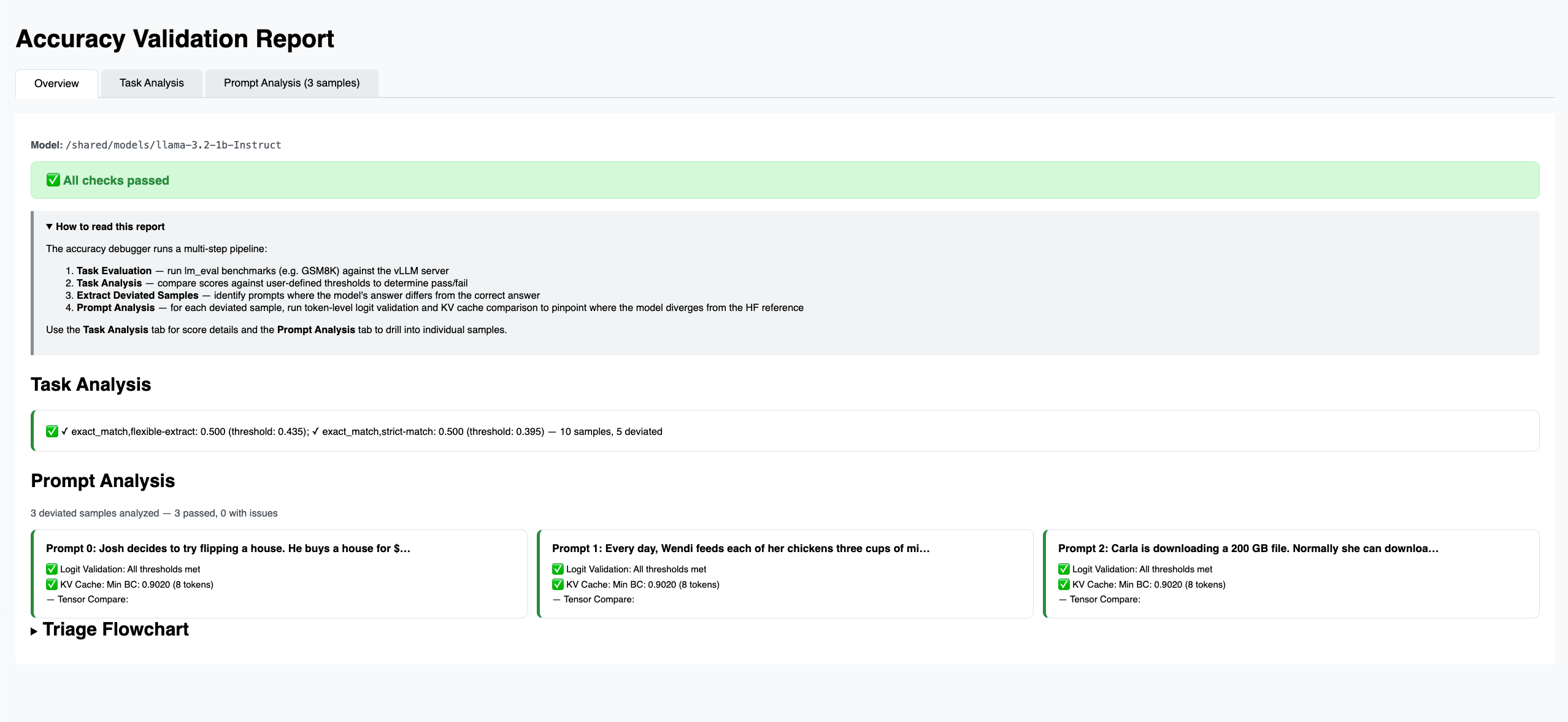
Status banner: green (all passed), yellow (minor deviations), red (failures).
Task Analysis section: whether scores met thresholds.
Prompt Analysis section: one card per prompt with logit/KV results.
Task Analysis Tab — Per-task scores, thresholds, and sample comparisons.
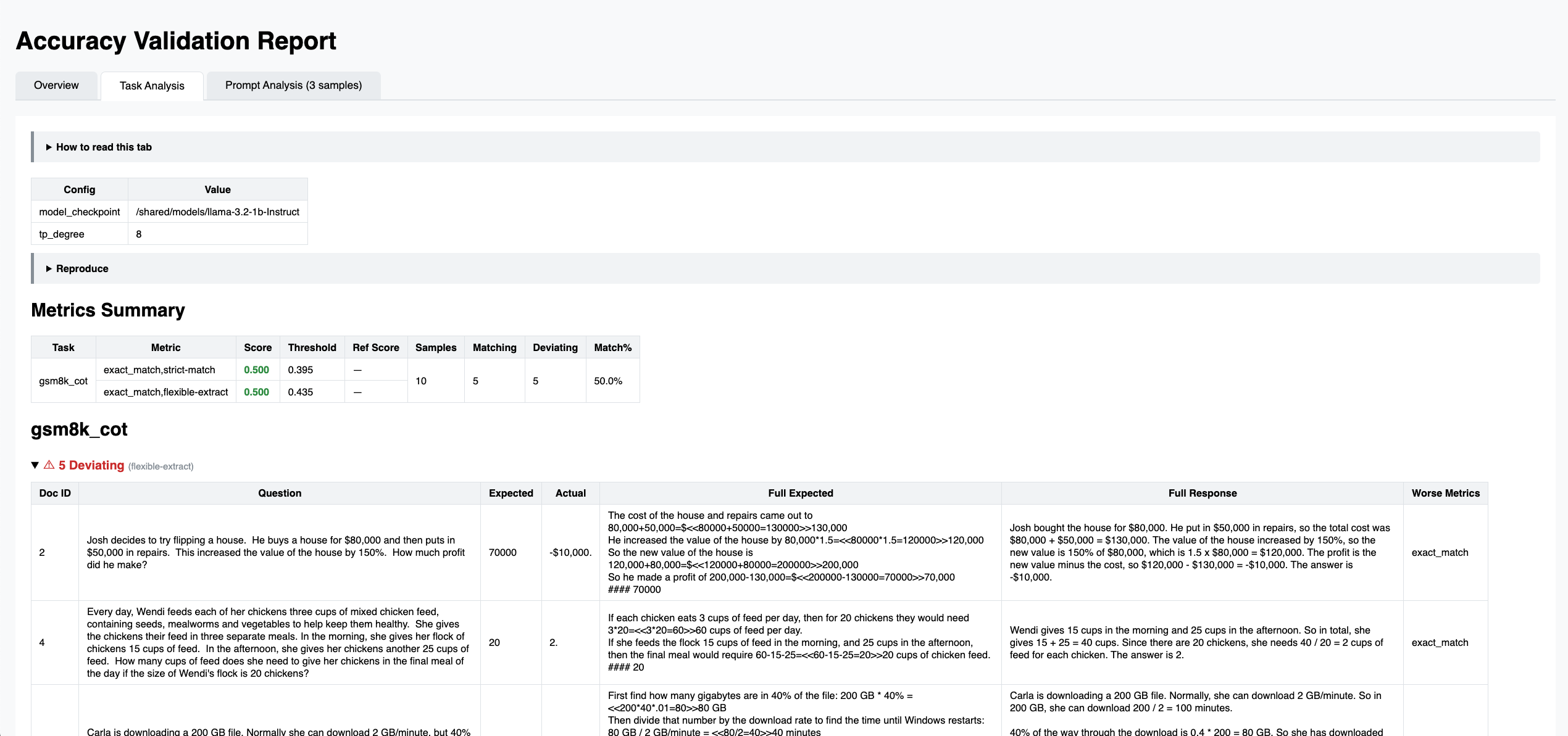
Metrics Summary table: score vs threshold with pass/fail indicators.
Deviating samples (expanded): question, expected answer, actual response.
Matching samples (collapsed): correctly answered samples.
Reproduce section: copy-paste commands to re-run the analysis.
Prompt Analysis Tab — Per-prompt logit and KV analysis with interactive plots.
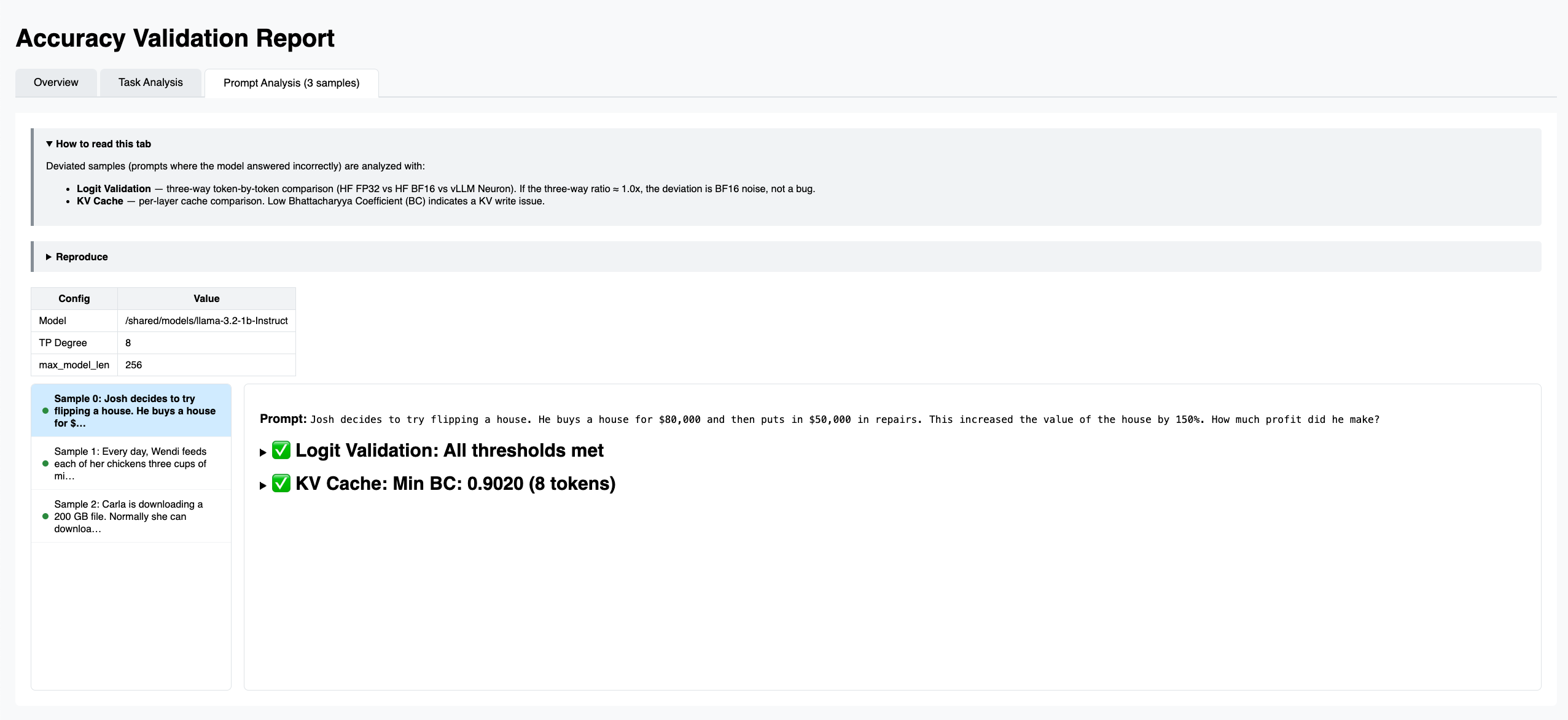
Sidebar: lists analyzed prompts with pass/fail dots.
Logit Validation: per-token L-inf/L2 error, BC, divergent token markers.
KV Cache: per-layer heatmaps with L-inf error and BC per attention head.
Reading logit validation results:
Three-way ratio ≈ 1.0x → dtype-inherent BF16 noise, not a bug.
Three-way ratio >> 1.0x → vllm-neuron-specific excess error.
BC ≥ 0.99 → error distributions nearly identical (good).
Token 0 fails → prefill bug.
Tokens 1+ fail, token 0 passes → decode or KV cache bug.
Output Structure#
accuracy_report/
├── combined_report.html          # interactive report with all tabs
├── run_config.json               # task and prompt eval configuration
├── eval_results/                 # raw lm_eval output
│   └── <model>/
│       ├── results_*.json        # aggregate scores
│       └── samples_*.jsonl       # per-sample predictions
├── task_analysis/
│   ├── task_report.txt           # scores vs thresholds, pass/fail
│   ├── task_status.json          # machine-readable scores + thresholds
│   ├── results_summary.json      # per-sample match/deviation details
│   └── deviated_prompts.json     # extracted prompts for prompt analysis
├── prompt_analysis/
│   ├── prompt_report.txt         # per-prompt validation summary
│   └── prompt_0/
│       ├── prompt.txt            # the prompt text
│       ├── validation_log.txt    # full validation output
│       ├── logit_validation/
│       │   └── logit_analysis_b0.html  # interactive logit plot
│       └── kv_analysis/
│           ├── kv_report.html     # interactive KV heatmap
│           └── kv_caches.pt       # raw KV tensors
└── tensor_compare/
    ├── comparison_summary.json   # per-module L-inf/L2 ratios and BC
    ├── hf_fp32/                  # HF FP32 captured tensors
    │   └── dp0/
    │       ├── prefill_s*/       # prefill captures per module
    │       └── decode_b*/        # decode captures per module
    ├── hf_bf16/                  # HF BF16 captured tensors
    │   └── dp0/
    └── neuron/                   # Neuron captured tensors
        └── dp0/
Failure Triage#
Logit validation fails
│
├─ Token 0 fails
│   └─ Prefill bug → check Tensor Compare for first divergent module
│
├─ Tokens 1+ fail, token 0 passes
│   ├─ KV Cache → high error at early tokens = KV write bug
│   └─ Tensor Compare on decode steps
│
├─ Three-way ratio ≈ 1.0x, BC ≥ 0.99
│   └─ Dtype-inherent error (BF16 noise), not a vllm-neuron bug
│
└─ Three-way ratio >> 1.0x
    └─ vllm-neuron-specific bug → Tensor Compare to isolate the layer
Glossary#
Term |
Definition |
|---|---|
Task-level analysis |
Evaluating model accuracy on a dataset and comparing aggregate scores |
Prompt-level analysis |
Analyzing individual deviated prompts with logit/KV/tensor comparison |
Logit validation |
Token-by-token logit comparison using top-k error maps and divergence metrics |
Teacher forcing |
Running inference with ground-truth tokens forced at each step, isolating per-token errors from autoregressive drift |
Three-way comparison |
Comparing across FP32 baseline, BF16 CPU, and BF16 Neuron with dynamic thresholds derived from baseline-to-expected error |
Bhattacharyya coefficient (BC) |
Statistical measure of overlap between error distributions, used to determine if Neuron errors are within expected BF16 range |
Tensor compare |
Layer-by-layer intermediate tensor comparison between HF and Neuron, using reconstruction to handle TP sharding and bucket padding |
Deviated prompt |
A prompt where the model produced a different (worse) answer vs reference |
References#
This document is relevant for: Trn2, Trn3